

There’s a particular kind of optimism that only exists in the first few weeks after you move somewhere new. Everything is a little bit of an adventure. The crappy regional grocery store chain is an adventure. The local radio stations are an adventure. You haven’t yet learned which parts of the place are going to wear you down — you’re just excited.
Fargo, North Dakota. 2010. I had just moved to the city to start grad school. I would eventually come to loathe Fargo with a depth and consistency that, honestly, still kind of impresses me. But back then? It was new. I was young(ish), I was eager, and I wanted to see what the place had to offer.
And lo and behold, it turned out that what the place had to offer was a nerd convention.
ValleyCon is a sci-fi/fantasy/everything-nerdy convention that’s been running in the Fargo-Moorhead area since 1977, which surprised me then and still kind of surprises me now. Hey, I like Star Wars. I like videogames. I spent an embarrassing chunk of my youth reading EGM and PSM cover to cover, staring at photos from E3 like they were dispatches from some distant, glorious kingdom that I would one day get to visit. And yet, despite all of that fantasizing, I had never actually been to a convention. Not once.
So I went.
ValleyCon 36 set up shop at the Doublewood Inn, and I’ll be honest with you: E3 it ain’t. There were no booths the size of houses, no pre-release demos, no blinding wall of screens. It was hotel conference rooms and folding tables. It was very much the Fargo, North Dakota version of the big, shiny things I’d read about as a kid.
But, hey, it was something. It was new and interesting and exciting, and I was having a genuinely good time just wandering around and soaking it all in.
The big literary draw that year was Timothy Zahn. Yes, that Timothy Zahn — the Heir to the Empire guy, the man who gave us Grand Admiral Thrawn and, by extension, a pretty solid chunk of my childhood. I went to his talk.
It was… disappointing. Deeply, disillusioningly disappointing, in that special way that only seeing a childhood hero in person can be. I’m not going to get into the details; let’s just say that I walked out of that room completely disappointed in what type of person he appeared to be.
The question
Alright, here’s what I actually wanted to write about. Dean Haglund was there, too — Langly, the long-haired one from “the Lone Gunmen,” The X-Files‘ resident trio of paranoid hackers. And he was doing a Q&A.
Now, I had never been to a convention before, so I didn’t know what to expect. What happened during the Q&A is what I now understand to be pretty much par for the course: a long line of fairly low-brainpower questions that the guy had almost certainly heard a hundred times before. Things like, “Are you guys making a new X-Files movie?”
To his credit, he handled that one firmly but in a not-meanspirited way. His answer was something along the lines of: “Well, let me ask you this. Everybody in the room, raise your hand if you saw the last X-Files movie in theaters.” A few scattered hands went up. “Okay. Well… there’s your answer.”
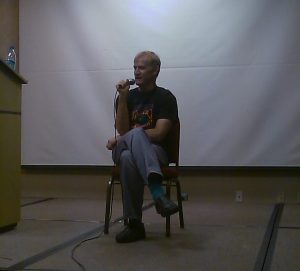
So, being a budding psychologist, I wanted to ask a psychological question. When my turn came, I asked him whether being involved in making film and television had changed how he experienced film and television — whether being on the other side of the camera changed what it was like to just sit down and watch something.
And, from my perspective, he lit up.
His answer was humble and thoughtful, and it’s something that has stuck with me for all of these years since. He said that it had made him vastly more generous in appreciating other people’s work. Nobody, he said, sets out to make a crappy movie or a crappy TV show. Even the stuff that seems laughably bad — he gave Sharknado as an example1 — is made by a whole lot of people who are really giving it their all, doing their best to make something good, if not great. So for him, it came down to this: even in the stuff that’s bad, he can see the good, and he can see what people are trying to accomplish.
It was a beautiful sentiment, to be honest. And he was so earnest about it — not “performing wisdom,” not doing a bit, just a guy who’d spent a lot of time on sets and come away from it all as a kinder, more generous, and more empathetic human being.
Seeing the good
I don’t really have a tidy way to wrap this up, other than to say that this one answer, from one Q&A, at one hotel convention in Fargo, has had a surprisingly large impact on me.
The obvious part is how I consume entertainment. Film, TV, videogames — I’m a lot more forgiving than I used to be. When something doesn’t quite work, my first instinct isn’t to dunk on it anymore. Instead, actually put in some effort to look for the thing it was trying to accomplish. The neat idea buried under a clunky script. The level designer who clearly had a vision and maybe not quite enough time.2 The song that has a really cool part but kind of… just doesn’t work outside of that. Somebody, somewhere, was trying really hard on this thing, and usually you can see it if you bother to look.
The less obvious part is that it bled into how I think about pretty much all types of work and effort, full stop. Other people’s work, sure — but also my own. My scholarly writing, my research projects, all of it. Nobody sets out to write a bad paper or run a bad study, either. Everything is a little bit flawed, and much of the world is made by people who were (mostly) doing their best with what they had. I make a concerted effort these days to see the good through the flaws, and that turns out to be a much nicer way to live than the alternative.
So thanks, Dean Haglund, for helping to shine some light on the world and shaping who I would eventually become. Sincerely.
And yeah, in fairness, I should probably extend a little of that generosity back to Timothy Zahn, too. Maybe he was tired. Maybe it was a long year on the convention circuit. Maybe he was doing his best, too, and just ended up finding himself stuck in a Doublewood in Fargo, North Dakota.
Nobody sets out to make a Sharknado.
Well — okay. Some people set out to make a Sharknado. But I bet they were trying really hard.
- A note for the pedants (hi, it’s me, I’m the pedant): Sharknado didn’t come out until 2013. So either Dean Haglund is a time traveler — which, frankly, would absolutely track for him — or my memory has swapped in a better example over the years. Maybe it was Sharktopus? But I’m pretty sure that it was Sharknado. Memory is reconstructive, folks. Ask any psychologist. ↩︎
- Side note: I’m a huge fan of the Double Fine documentaries by 2PP. Why, I even wrote to them once upon a time. ↩︎